From Data to Hazard Modelling (hackathon) + Earthquake and Tsunami Cascades
Geo-INQUIRE is organizing a Workshop on seismic and tsunami hazards for 30 PhD Students, PostDocs, and early-career scientists from the fields of Solid Earth and Ocean and their interface.
Date: Monday, 20 April 2026, from 9:00 CEST to Thursday, 23 April 2026, 18:00 CEST.
Registration: Closed on Sunday 8 February 2026 (23:59 CET).
Location: Royal Palace Hotel in Messina, Italy (https://www.royalpalacemessina.it/)
Messina is a major port city located on the western side of the homonymous Strait of Messina. Directly across the Strait, on Italy’s mainland, lies the port city of Reggio Calabria. Both cities were nearly destroyed by a devastating earthquake that occurred on 28 December 1908, with a moment magnitude of 7.1 and a maximum Mercalli intensity of XI (Extreme). The earthquake epicenter has been pinpointed within the Strait, and the nearby coasts were struck by strong tsunami waves. With a 120,000 death toll, the 1908 event remains the deadliest earthquake in the history of Europe, and a tragic example of seismic and tsunami hazards combined.
Organizing institution: National Institute of Geophysics and Volcanology
Organizers: Stefano Lorito (INGV), Roberto Basili (INGV), Laurentiu Danciu (ETHZ), Maria D’Amico (INGV), Manuela Volpe (INGV), Giovanni Bianco (INGV), Sara Fusi
Contact: Maria D’Amico
Scope: This multidisciplinary workshop bridges the gap between raw geoscientific data and actionable hazard analyses, both scientifically and technically. The workshop will use Geo-INQUIRE data and software to explore/develop Probabilistic Hazard Analysis for both earthquake ground motion and tsunami waves, considering both seismic and non-seismic (landslide) sources.
Learning goals: Understand the theoretical foundations of probabilistic hazard analysis through dedicated lectures and explore case studies through hands-on sessions. In-depth examination of similarities and differences between ground-shaking and tsunami hazards.
- Navigate and extract data from the latest European data products and services available through EPOS and Geo-INQUIRE for Geohazard Analysis.
- Execute end-to-end hazard calculations using state-of-the-art software.
- Perform hazard disaggregation to identify the primary contributors (magnitude, distance, epsilon) to the hazard at a specific site.
- Develop scenarios based on probabilistic results.
Description: The workshop focuses on Probabilistic Seismic Hazard Analysis (PSHA) and Probabilistic Tsunami Hazard Analysis (PTHA), featuring a program that includes lectures and hands-on activities based on the latest releases of European datasets for earthquakes (catalogues, ground motions), seismogenic faults, and submarine landslides. It will utilize state-of-the-art software tools to calculate both seismic and tsunami hazards, as well as to perform hazard disaggregation, scenario selection, and modeling. All provided via Geo-INQUIRE installations (including but not limited to VA2-33-1, VA2-33-11, VA2-33-2, VA2-33-5, VA2-33-6, VA2-33-7, VA2-33-10, VA2-34-1, VA4-532-2, VA4-532-4, VA4-532-6) and other resources from the EPOS-ERIC TCS-Seismology (EFEHR) and TCS Tsunami.
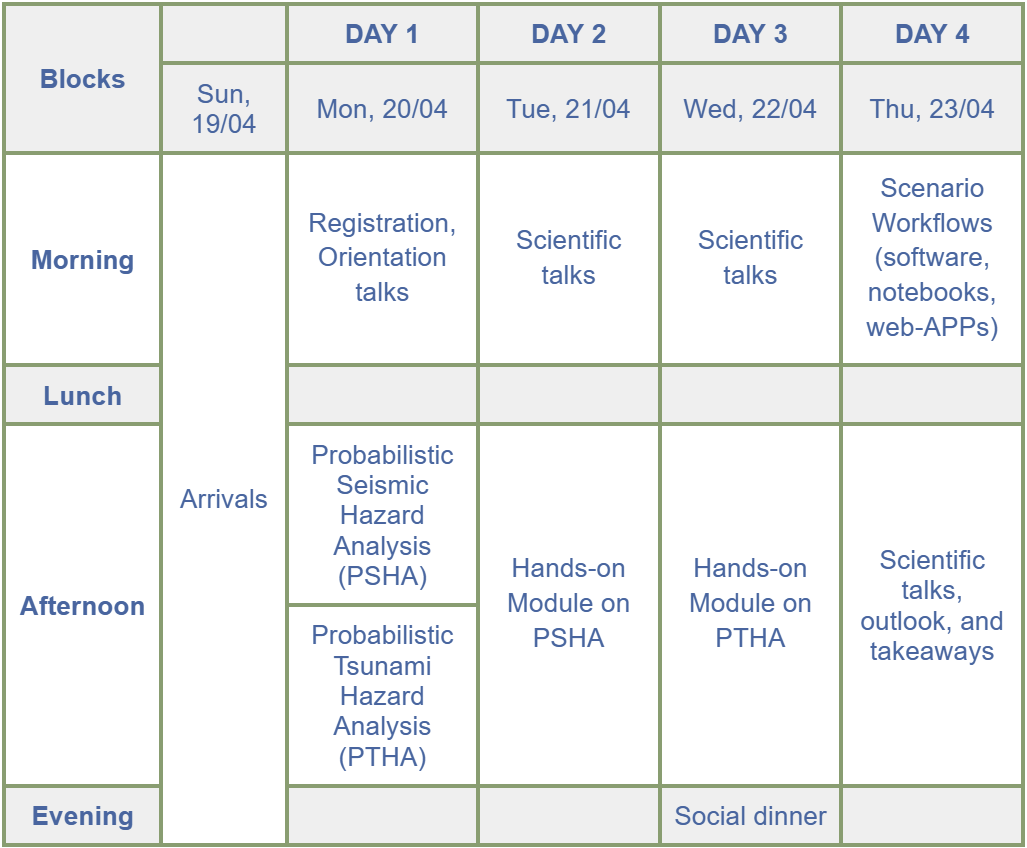
Preliminary program:
Speakers:
- Roger Urgeles (CSIC), Savas Ceylan, Laurentiu Danciu (ETH), Andrey Babeyko, Graeme Weatherill (GFZ), Gareth Davies (Geoscience Australia), Roberto Basili, Giovanni Lanzano, Stefano Lorito, Francesco E. Maesano, Alessio Piatanesi, Andrea Rovida, Antonio Scala, Gianluca Valensise (INGV), Thomas Ulrich (LMU), Bill Fry (NGS New Zealand), Finn Løvholt (NGI), Fatemeh Jalayer (UCL), Manuel J. Castro (UMA).
Financials:
For successful applicants, the workshop organization will cover the following expenses: hotel accommodation for up to 5 nights (Sunday in - Friday out), welcome reception, 4 lunches (Monday to Thursday), coffee breaks, one social dinner (Wednesday), and conference materials. Attendees will have to book tickets to Messina and pay in advance. After successful participation, travel costs can be reimbursed up to a maximum of € 500.
Logistics:
- Hotel: Accommodation will be provided in single rooms.
- Transportation to/from the venue: Information will be provided to the applicants selected for participation.
Requirements:
The application is open to everyone; however, PhD Students, PostDocs, and early-career scientists from the fields of Solid Earth and Ocean, as well as their interfaces, will be prioritized. Workshop applicants should have a strong interest in the topics listed above, such as earthquake and tsunami hazards, as well as the modeling of earthquakes and tsunamis generated by both earthquakes and landslides.
Programming skills, computing knowledge, and user-level Linux skills will be positively considered during the evaluation of applicants. Students will need to bring their own laptops, which may be used to run Jupyter Notebooks and establish an SSH connection.
The workshop language will be English.
Application:
All applicants must complete the registration form and include a motivation letter. Completion of the form does not mean automatic acceptance of the participant. Due to the limited number of seats, a selection of participants will be made based on the information provided during registration. Participants will be informed of their acceptance to the event via email after the selection process is complete. The selection will be based on the analysis of the motivation letters, and inclusion criteria by the scientific organization committee. After a participant is selected, submitting the travel information booked by the participant is mandatory to confirm participation in the workshop.
A waiting list may be created and used in case any issues arise with the selected participants. If you have special dietary requirements or require additional assistance, please indicate this in the application form. Please also contact us if you require assistance with applying for a visa or have any other doubts, even before submitting the application.
Timeline:
15.01.2026:Opening of Registration
08.02.2026: Registration Deadline (23:59 CEST)
18.02.2026: Notification to applicants (selected and waiting list)
01.03.2026: Confirmation of attendance (including travel details). The seats of non-confirmed applicants will be reassigned.
04.03.2026: Notification to applicants on the waiting list, if necessary
16.03.2026: Confirmation of attendance (including travel details) by applicants from the waiting list.
Inclusion criteria:
We aim to make the workshop an inclusive event. Geo-INQUIRE promotes diversity and inclusion within the scope of the project, including the applications for the Geo-INQUIRE Messina Workshop 2026. Therefore, applications from female colleagues and applications from colleagues working in one of the widening countries, associated countries, and outermost regions of Horizon Europe will be given special attention during the evaluation process.
Applications from candidates with special needs are welcome and will be given due consideration in the selection process. Please indicate your needs in the registration template.
Widening countries are Bulgaria, Croatia, Cyprus, Czechia, Estonia, Greece, Hungary, Latvia, Lithuania, Malta, Poland, Portugal, Romania, Slovakia, and Slovenia. Associated countries (allowed to coordinate widening projects) include Albania, Armenia, Bosnia and Herzegovina, the Faroe Islands, Georgia, Kosovo, Moldova, Montenegro, Morocco, North Macedonia, Serbia, Tunisia, Turkey, and Ukraine. The outermost regions include Réunion, Mayotte, the Canary Islands, the Azores, Madeira, Saint-Martin, Guadeloupe, Martinique, and Guyana.