

Joint SeisSol & ExaHyPE User Workshop, Training and Hackathon
Date: Thursday, 11 June 2026, from 8:30 CEST to Friday, 12 June 2026, 16:00 CEST.
Location: Leibniz Supercomputing Centre (LRZ), Boltzmannstr. 1, 85748 Garching bei München, Germany.
Presentation Material:
Welcome and Introduction:
[pdf] Michael Bader (TUM): Welcome Note, Basic overview of SeisSol & ExaHyPE
Scientific talks 1 (SeisSol):
[pdf] Rachel Preca Trapani (LMU): Do 3D Dynamic Rupture Models Capture the Variability in Long-Period Velocity Pulses? Insights from the 2023 Mw 7.8 Kahramanmaraş Earthquake
[pdf] Thomas Ulrich (LMU): Rupture dynamics on a mature strike-slip fault: insights from ensemble modeling of the 2025 Myanmar earthquake
[pdf] Fabian Kutschera (Scripps): Untangling seismo-acoustic and gravity waves in 3D fully coupled earthquake-tsunami simulations
Nico Schliwa (ETHZ): Forecasting induced microearthquakes in the BedrettoLab with SeisSol
Scientific talks 2 (ExaHyPE):
Han Zhang (Durham Univ.): ExaGRyPE: How we build a Numerical relativity code with ExaHyPE 2
[pdf] Steven J. Gibbons (NGI): Landslide and tsunami simulation using ExaHyPE and HySEA
Chung Ming Loi (Durhan Univ.): User Friendly Tsunami UQ Application with ExaHyPE and UM-Bridge
[pdf] Mario Wille (TUM): ExaHyPE on GPUs
Scientific talks 3 (SeisSol):
[pdf] Gabrielle Hobson (UCSD): Mesh Morphing and Model Order Reduction for Earthquake Dynamic Rupture on the Southern San Andreas Fault
Sébastien Hok (ASNR): Different applications of SEISSOL in the scope of seismic hazard assessment
[pdf] Daniel Dreier (Univ. of Padua): Formation of fault damage zones in carbonates
Mathilde Marchandon (LMU): Multi-segmented rupture, coseismically-triggered aseismic slip, and shallow rake rotation during the 2025 Mw 7.1 Tingri, South Tibet, earthquake
Scientific talks 4:
[pdf] Iris Christadler (LMU): Geo-INQUIRE Transnational Access, SDL & Training Program
[pdf] Shane Murphy (IFREMER): Stochastic Slip distributions on non-planar faults described by unstructured mesh
[pdf] Olindo Zanotti (Univ. of Trento): High order numerical schemes within a new first-order BSSNOK formulation of the Einstein equations
Alice Gabriel (Scripps/LMU): 20 Years of SeisSol and 10 Years of ExaHyPE
Evening talk:
Michael Dumbser (Univ. of Trento): A simple and general framework for the construction of exactly div-rot-grad compatible discontinuous Galerkin finit
SeisSol Tutorial (Friday):
[pdf] A.-A. Gabriel, F. Kutschera, G. Hobson, V. Kurapati, M. Marchandon, D. Schneller, Th. Ulrich: Introduction to 3D Dynamic Rupture and Seismic Wave Propagation Simulations with SeisSol
- Post on ChEESE website
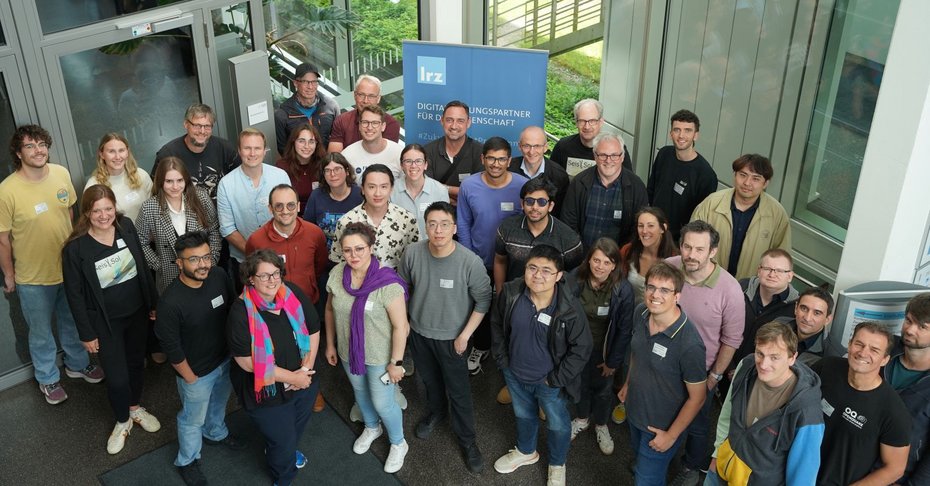
In celebration of 20 years of SeisSol and 10 years of ExaHyPE, we are happy to announce
- The first Joint SeisSol+ExaHyPE User Workshop,
- A combined SeisSol+ExaHyPE User Training,
- The first SeisSol+ExaHyPE Hackathon,
will take place on June 11th and 12th, 2026 in Garching (Munich), at the Leibniz Supercomputing Centre.
Organizers: Michael Bader (TUM) Alice-Agnes Gabriel (LMU, Scripps), Tobias Weinzierl (Durham University)
Contact: Iris Christadler (Iris.Christadler lmu.de)
Geo-INQUIRE Installation: SeisSol/ExaHyPE virtual access (VA4-531-1) and transnational access (TA2-531-1).
Speakers: For the user workshop (June 11), we call for contributed talks on the usage and development of SeisSol or ExaHyPE, and closely related topics. If you are interested in contributing, please add the title of your talk in the registration form.
Event type: on-site. Parts of the program may be made available via streaming or recordings.
Target audience: The user training and hackathon (June 12) addresses new/potential and existing users of SeisSol and ExaHyPE. We will offer (partly parallel) tracks on:
- solving hyperbolic PDE systems with high-order discontinous Galerkin methods using SeisSol and ExaHyPE
- Earthquake simulations with SeisSol
- ExaHyPE use cases from seismology to astrophysics
- Performing seismic simulations with SeisSol (hands-on session)
- How to implement your own hyperbolic PDE solver in ExaHyPE (hands-on session)
- Astrophysics with ExaHyPE
Existing and more experienced users of SeisSol and ExaHyPE are invited to discuss issues of usage, optimisation, and further development of SeisSol and ExaHyPE during our Hackathon session on June 12.
Prerequisites: To attend the SeisSol training on Friday, basic Linux user-level skills are enough; for the ExaHyPE training, Python and C++ skills are required. Please bring your own laptops.
Maximum number of participants: The Friday training sessions are limited to ~30 participants. Please specify which training or hackathon you would like to attend in the registration form.
Timeline:
11.05.2026: Registration Deadline extended (noon - 11:59 CEST)
12.05.2026: Notification for speakers and attendees
11.05.2026: Last possibility to resign, inform waiting list
Logistics:
Conference fee:
We ask for a contribution of 60€ to cover meals. This includes lunch and the social dinner on Thursday, a Bavarian "Weißwurstfrühstück" on Friday, and coffee breaks.
Accommodation:
Please book your accommodation individually. There are several hotels in Garching or Ismaning, or in northern Munich along the U6 subway line. The Courtyard by Marriott and Stellaris Apartment Hotel Garching are directly on campus.
Transportation to/from the venue:
The Leibniz Supercomputing Centre is located close to the subway station "U6 Garching-Forschungszentrum". From Munich main station, you will need ~45 Minutes to reach LRZ by S- and U-Bahn (transfer at Marienplatz). From the airport, take the S8 and alight at Ismaning. From there, take the regional bus 230 towards Garching-Forschungszentrum. Reserve 45-60 minutes for this trip.
Special requirements:
If you have special dietary requirements or require additional assistance, please indicate this in the application form. Please also contact us if you require assistance with visa applications or have any other questions, even before submitting your application.
Geo-INQUIRE and ChEESE-2P:
The SeisSol and ExaHyPE User Workshop and Training is supported by the projects Geo-INQUIRE and ChEESE-2P.
Inclusion criteria: We aim to make the workshop an inclusive event. Geo-INQUIRE and ChEESE-2P promote diversity and inclusion within the scope of the projects. Therefore, applications from female colleagues and from colleagues working in one of the widening countries, associated countries, or outermost regions of Horizon Europe will receive special attention during the evaluation process. Widening countries are Bulgaria, Croatia, Cyprus, Czechia, Estonia, Greece, Hungary, Latvia, Lithuania, Malta, Poland, Portugal, Romania, Slovakia, and Slovenia. Associated countries (allowed to coordinate widening projects) include Albania, Armenia, Bosnia and Herzegovina, the Faroe Islands, Georgia, Kosovo, Moldova, Montenegro, Morocco, North Macedonia, Serbia, Tunisia, Turkey, and Ukraine. The outermost regions include Réunion, Mayotte, the Canary Islands, the Azores, Madeira, Saint-Martin, Guadeloupe, Martinique, and Guyana.
Geo-INQUIRE is funded by the European Commission under project number 101058518 within the HORIZON-INFRA-2021-SERV-01 call. Terms and Conditions for participants in Geo-INQUIRE activities: https://www.geo-inquire.eu/about/terms-and-conditions
ChEESE-2P is funded by the European High Performance Computing Joint Undertaking (JU) and by national funding from Spain, Italy, Iceland, Germany, Norway, France, Finland and Croatia under grant agreement No 101093038.